April 4, 2010- BGEE

April 4, 2010- BGEE
Best Greek Easter Ever

Friday, September 24, 2010

Angela's Visit, Nelson, and News

Angela tramping in Abel Tasman NP
My sister Angela was the second family member and first Wallace to come to see us in New Zealand, but the visit almost did not get off the ground. First, she changed the dates of her visit due to a scheduling conflict with a meeting in New Jersey, then with the Sept. 4th Christchurch quake, her Organizers conference here was canceled. She managed to fly in anyway on Sunday, Sept. 12th and came up to Timaru two days later. I was able to rearrange my work schedule on short notice and got off Thursday night the 16th until the 22nd. My original plan was to head to the northern part of the South Island, but aftershocks continued and caused a slide across the main road. Next idea: head south, over the Southern Alps to the West Coast. But, the day of departure, the headlines read "Storm the size of Australia to bring snow, rain, and high winds to New Zealand" Not wanting to become snowbound and reenact "The Shining" or "Misery", it was back to Plan A.
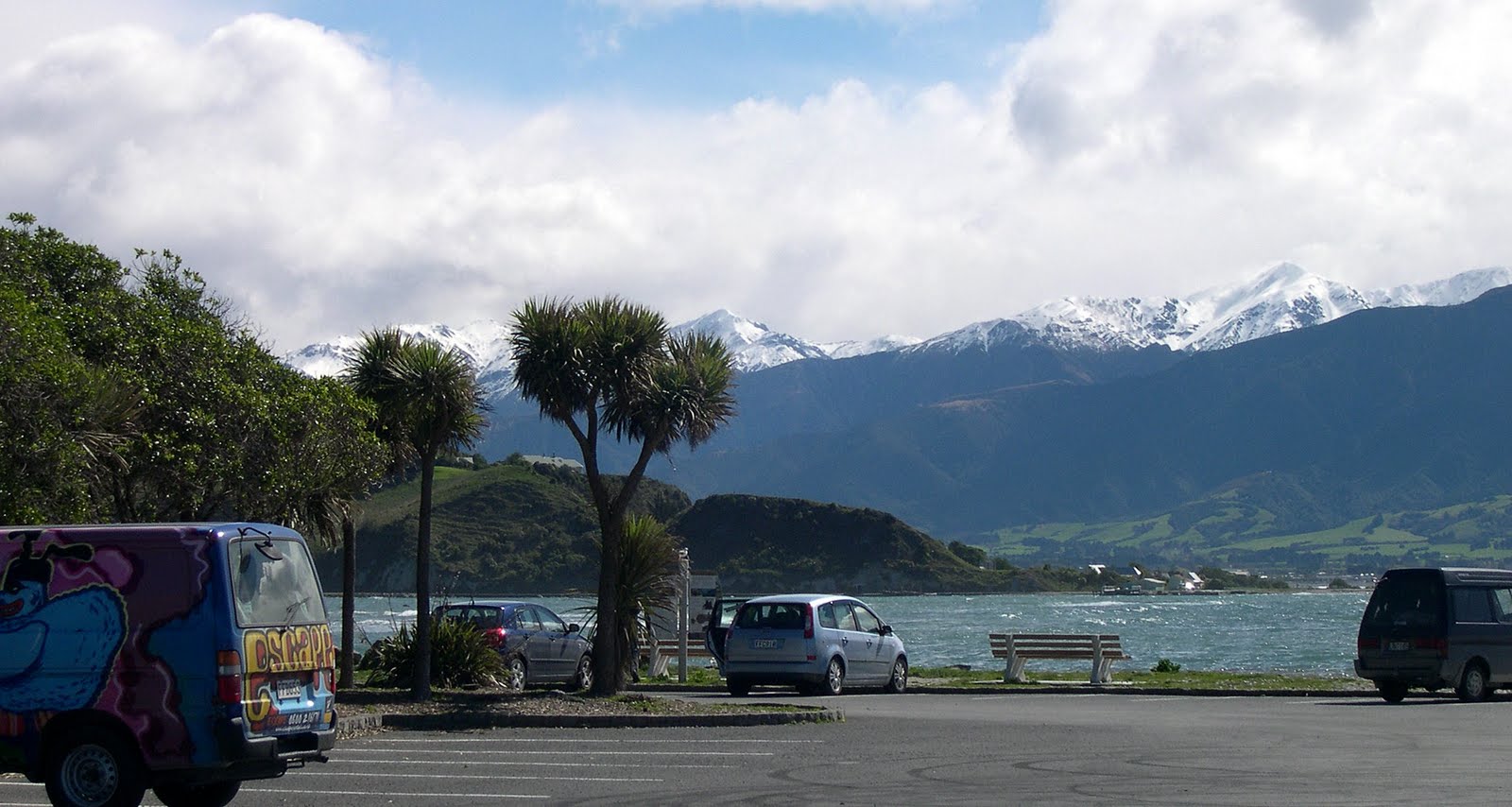
Turns out, that was the right call, despite some 4.4 aftershocks in Christchurch. Highway One just south of Kaikoura had been closed due to a quake-related slide, but that was cleared the night before we passed through. We drove in and out of the rain, but were lucky to stop mostly during breaks in the weather. This was true in Kaikoura, a formerly sleepy seaside village with a dramatic backdrop of nearby 8,500' snow-capped peaks.
It is now a tourist mecca, known for nature cruises and seafood, especially very large crayfish (which we would call spiny lobsters). Colonies of sperm whales live in the bay, and the locals are so confident they will appear, they will refund your whale-watching cruise fee if you don't spot some. We didn't have time for a cruise then, but definitely I will return to do that. Given the iffy weather, we pushed on to Nelson, our goal for the night. Nelson has a reputation as home to retirees and counter-culture and artistic types, and mild weather. It is also the gateway to Abel Tasman National Park, a seaside wilderness area, and many peoples' favorite place.
I can't disagree.
We ended up spending three nights in a very luxurious suite in Nelson, allowing a full day to explore the city environs. We climbed Botanic Hill to the "Centre of New Zealand" (a dubious claim) for a lovely view.
Also worth visiting was the WOW (World of Wearable Art) & Classice Car Museum.
Angela and Fayne in a 2001 Plymouth Prowler
Couture Design by Smith featured at the WOW Museum in New Zealand
The area around Nelson is a rich agricultural area, growing apples, Kiwi fruit, citrus, and hops. We were able to participate in the extended, country-wide New Zealand Film Fest (our fourth venue) and saw "Exit Through the Gift Shop" [a "prankumentary" in my opinion (not my neologism, alas)], and the delightful "Babies". And of course there were many lovely beach scenes.
After Nelson, we headed south through Murchison and the Buller River Gorge and across Lewis Pass to the alpine village of Hanmer Springs. The weather this day was the worst of the trip, with steady driving rain and slushy snow over the pass. Fortunately, we didn't have to put on the chains, and we missed the heavy snow in the far south that caused roofs to collapse in Invercargill. Hanmer Springs is noted for the natural hot springs and baths, a bit like a tiny version of Calistoga. There is only one city-run hot springs, the water could have been hotter, it was under construction, and it was a bit more "family-oriented" than I expected.
(A little bit like this)
(but more like this)

The village surroundings could not have been more lovely, with beautiful pastoral walkways through the early spring woodlands.

From there it was back to Christchurch Tuesday night to see Angela off Wednesday the 22nd morning (one day before her **th birthday). Hopefully, her NZ visit was worth all the trouble. We were surprised to find many Christchurch hotels booked, teeming with people coming in to assess and appraise the damage, do repair work, residents displaced from their homes, and some Metallica fans in for there two concerts "to save Christchurch". As they say, it is an ill wind that blows no good. On the way home we saw some evidence of the quake damage.
A secured turret from the Great Hall at the Arts Centre
A severely damaged church near the epicenter
Now the news. I was originally contracted to work in Timaru through the end of October, but I am enjoying the work, the pay is good, they have a need and appreciation for my services here, and there is still a lot of NZ I want to see. That has led to a revision of our plans to work six months, travel for six months. I have committed to work here through March 1, 2011, and will be taking three weeks off over the holidays to come back home for granddaughter Kimarra's birthday and Christmas and New Years with family and friends. We plan to come to Fort Bragg late in December before returning to NZ. Post-NZ plans are less clear but I expect we will travel for a few months, and be back home no later than Sofia's BD June 20th. It is exciting but somewhat stressful having so many options from which to choose. (Did I hear someone say "boo frigging hoo!!"?)

Monday, September 6, 2010

Reflections on an Earthquake

The earthquake in nearby Christchurch made the international news, and a lot of our friends and family must have been a bit worried at first. Most of my blog followers have experienced earthquakes, and I know my musings are not unique.
vancouverite.com
 Fayne and I were both awaken about 4:30 am Saturday Sept 4th first by a sound-a low, deep rumble. Our house being no more than 0.5 km from the shore, the first thought was there was a strong wind coming in over the sea, but as it slowly grew in intensity, we quickly recognized it as a temblor. It lasted a long time, well over a minute. The room rather gently rolled, then gradually abated. Nothing in our sparsely furnished 100 year-old home fell or was damaged. We were alert, but not overtly frightened, ans felt no grave danger. There was a second strong after-shock about 20 minutes later, the first of many over the next few days (one just occurred as I am typing this). We were awake and alert. I got up to see if there was any news on NZ TV. There was none. We went back to bed. Being right across the street from the hospital, I could hear no sirens or traffic, and assumed there was no significant local destruction or injuries (only a few church steeples were damaged in Timaru).

When you have lived in earthquake country, there a lot of questions that cascade through your mind, such as:

1) Where was the epicenter? A small quake under your house is felt much more than a large one far away. In this case, the center was 20 miles west of Christchurch, about 120 miles from here, in Darfield, a small town on the TranzAlpine train route.

2) Was anyone hurt? You know you may just been on the border of a tremendous tragedy, or not. Miraculously, no one died in the quake. If it had occurred in daytime, almost certainly some would have.

3) Would there be bridges down, dams broken, fires, or a tsunami? There was some significant damage to old brick buildings, some were destroyed, and a few fires due to downed power lines, gas leaks, and broken water mains, but the emergency response was great. The Christchuch Hospital was back onto full power within a few hours. There were a few small rural bridges down, cracks in roads, but no tsunami warnings.
dailymail.co.uk
4) Are friends and loved ones safe?  Two families from there in particular have been most kind to us, as detailed in previous blogs. Michelle Dhanak and family and home were fine, and worried mostly about the water and sewage issues. David Cohen (Paula's brother) and family were safe, but unfortunately suffered more damage to their home and flooding and debris in the yard and neighborhood. Our thoughts are with them.

I believe what is so fundamentally upsetting about earthquakes is that throughout life, our ultimate point of reference is the solid ground beneath our feet. Numerous figures of speech reflect this: rock solid, mother earth, being grounded, have your feet on the ground, etc. With other natural dangers, be it wind, rain, flood, snow, or lightning, we can seek refuge on or in the ground. If you can't trust the earth, where can you be safe?

It is also not too comforting to listen to the experts. We always hear "but this wasn't the big one we are expecting". Also, it seems often the fault line is one not previously know. I think things are always a lot clearer in retrospect, analyzed after the quake. (Not too helpful). However, I don't think many people regret the seismic retrofitting done here or in the states. I am sure there would have been much more destruction of the historic stone buildings without it.

We are left thankful that most of these events are far less tragic than they could be, and aware that there are so many things in life over which we have no control. We can always build new buildings, as Helen, one of the secretaries here, reminded me. And we can take heart in they way most people respond and rise to a crisis and pull together.

It is unclear at this point how this will effect my sister Angela's plan to attend a conference in Christchurch next week. We shall see.

Also, we wish a very happy birthday to my mother Billie Hope, born on September 6th, 19**. We love you.
Wednesday, September 1, 2010

The Last Train To Greymouth

(and the first- just one daily)
One of the first things that caught my fancy about visiting New Zealand was reading about the train trip across the southern alps, the TranzAlpine Express (they love to make words and phrases incorporating NZ, pronounced "En Zed"). My resolve was set when I learned that Jonathan and Heidi Pace were now living in Greymouth, the western terminus. The Paces were in Fort Bragg for several years, and then set off wandering a bit before landing in Greymouth in 2005. He is a general surgeon and she is a therapist, and they are both happily settled now, with two sons currently living at home. We have been in touch via email, and we booked a trip the weekend of August 21st. We boarded the train just outside of Christchurch, in Rolleston, where the "station" is a bare track-side platform. It was cold and dreary at the onset, but as the train slowly climbed through the broad Canterbury plains to Arthur's Pass (elev. 737 m/2,417 ft) , clouds and sun began to appear. 
The building of the railroad must have been quite a feat, as the tracks wind through steep gorges, over four tall viaducts, and through 19 tunnels, with the Otira Tunnel an impressive 5.3 miles long. On the west side, we slowly descended by lovely lakes
Lake Brunner
following the Grey River down to the Tasman Sea to the town of Greymouth. Heidi Pace graciously met us at the station, we dropped our things off at the motel, and went to their home for coffee and a snack. Jon was on call for surgery, so we arranged to meet up with him later. Fayne and I had time to take a walk out on the pier at the edge of town.
Heidi suggested we go to a talk at a local gallery where a Kiwi author was discussing his new book on the Tasman Sea, which served as an introduction to our visit to the region. We finally met up with Jonathan at a local funky restaurant where there was an impromptu meeting of hospital people.
Sunday morning they showed us around the hospital and about town. He was making an effort to recruit us to come there, but the weather isn't the best, and the town suffers from periodic devastating floods, most recently in 1988. They finally built a tall flood wall ("the Great Wall of Greymouth"), but many of the old buildings did not survive over the years. Here is a look from the flood wall down a main street

and a look back up the river.

The Paces could not have been more hospitable, and overall we had a great visit.
Jon and Heidi in front of the station
On the trip back, I tried to be out on the viewing platform as much as possible to better enjoy the scenery and get some blog-worthy photos. Here are a few as we wound back through broad rivers, by snow-capped mountains, and over deep gorges.


Every place we have been in New Zealand seems more beautiful than the last. If only I can find a train trip with penguins on it.......Hmmmmm.

Monday, August 16, 2010

Dùn Èideann, a Cursed Castle, and Royal Gooney Birds

The last of New Zealand's four major urban centers was visited was Dunedin.The name comes from Dùn Èideann, the Scottish Gaelic name for Edinburgh, the capital of Scotland (Wikipedia). It lies about a 2 1/2 hour drive south of Timaru, down Highway 1. It is most notable for four things:
1) Higher Education (University of Otago, New Zealand's first university (1869), and the Otago Polytechnic are here and the larger of two NZ Medical schools);
2) The Cadbury Chocolate factory;
3) The Speight's Brewery; and,
4) It is the Gateway to the Otago Peninsula, a beautiful 15 mile-long finger into the Pacific with lovely views and abundant wildlife.

As you might guess from its name, Dunedin is at heart a Scottish town. It even features some Scottish restaurants (although I don't think many go to Edinburgh for the cuisine). The most famous and photographed building is Railway Station, a 1906 monument to "Flemish Renaissance" architecture.

It is quite special inside and out, and the stone masonry, tile work, floors, and windows are all marvelously well-cared for. On weekends, there is a large and bustling organic Farmer's Market in the parking lot.

Being a lover of museums since childhood (having been left behind on numerous family trips reading every last label on the displays), our next stop was the Otago Museum, next to the University. Especially impressive was the fin whale skeleton below.

Since we were only down for a quick weekend, after Saturday we hardly had time to make a list for what we will do and see on our next visit: the brewery tour, a train excursion, the Otago Festival of the Arts in October featuring a recital by famed Kiwi Soprano Kiri Te Kanawa and an encore performance of the play "Heat" with the previously described full-frontal penguin nudity.
Sunday, it was time for a quick trip down the peninsula before returning home. The high road runs along its spine and on the highest point is an oddity: Larnach Castle, "New Zealand's only castle".
I won't bore you with a semantic debate over whether it really is a true castle, but it is a Very Impressive edifice with an appropriately tragic operatic tale to tell. Briefly, Mr. William Larnach was a wealthy Australian banker/entrepreneur/politician not so fortunate in his private life. He spared no expense and brought craftsmen from all over the world to build what he called "The Camp" to impress his wife Eliza, reputedly descended from French royalty. The workmanship was magnificent, but she was not impressed, and the children hated it too. Eliza died suddenly of "apoplexy", so he married her sister, who by all accounts was a stone-cold b****. She died suddenly five years later of "blood poisoning". Not deterred, he took a third, beautiful trophy wife Constance, 21 years his junior. In 1898, at the age of 65, beset by financial reversals and impending bank failure and haunted by rumors of an affair between his young wife and his favorite son, he committed suicide in Parliament.
View from the tower
The surrounding gardens are quite rightly famous.
For a daughter's  21st birthday he built her this ballroom. She died five years later of typhoid.

It should come as no surprise that it is said several ghosts walk the halls at night.

From the castle, off to the tip of the Otago Peninsula to visit the Royal Albatross Center. These amazing seabirds can have up to a nine-foot wingspan, and this is a rare place where you can see their nests from a bunker. The chicks hatch in January, and then stray no more than a few feet from their nests, fed by their parents, for the next nine months. They start to fly in September. Once they get the hang of it, they take off eastward for two to three years, allegedly not alighting on land until returning to their birthplace to nest. Hard to imagine. I am sorry my photo equipment could not get better long-range shots of these two fuzzy chicks

or this adult albatross.

Around the path from the parking lot there was another idyllic lighthouse/Pacific ocean scene.

Saturday, August 7, 2010

"I'll take New Zealand for $800, Alex"

Let's say you are preparing for Jeopardy! and the category is New Zealand, one of the five "questions" you should expect would be:" Who are the All Blacks? ", in reference to their adored national rugby team.
As the tango is to Argentina, so is rugby to New Zealand. It is hard to fathom how deeply many (but not all) Kiwis feel about their team. I was not going to live in NZ and not go an All Blacks game. It took some time getting up to speed with the game of rugby, previously a deficiency in my sporting oeuvre, as my friend Curtis would say. I should have been more knowledgeable, since the Berkeley Golden Bears are a perennial NCAA powerhouse. Once you get into it, you can see that rugby and American football come from a common ancestor. It is strangely familiar: kicks, field goals, scrimmage, conversions, tackling, tries (the TD equivalent:in rugby since you only get points crossing the goal line when you "touch down" the ball to the ground). Yet it is oddly different too (scrums, rucks, mauls, line outs).
The All Black team (named for the all black uniforms) has been at or near the top of the rugby world since the turn of the 20th Century. It has long been common ground for the Maori and Europeans: the first rugby international superstar was the Maori man George Nepia.
NZ will be hosting the World Cup of rugby Sept-Oct 2011, and the preparations are evident everywhere. There are large billboards and countdown clocks and daily news reports of stadium upgrade delays and controversies over tearing down old sheds on the Auckland waterfront to create a huge tent for "party central" to entertain visitors. On the field preparations include selecting the elite All Blacks 2010-11 squad, and tuning up with traditional matches ("tests") against major competition, such as the South African Springboks
A springbok
and the Aussie Wallabies in the Tri-Nations Cup Series, pitting the three Southern Hemisphere powers against one another in a "round robin"  tournament. We might consider these "exhibition" games, but they are bigger than that.
We were fortunate enough to get tickets to see the AB's vs. the Springboks in Wellington, July 17. This was the match-up featured in the Clint Eastwood/Morgan Freeman/Matt Damon film "Invictus", telling the tale of how Nelson Mandela helped to unite a nation through rugby. The Kiwis have a different take on the 1995 World Cup, remembering it as a dark day, when the superior AB team was undone by the South African home team, possibly aided by some "home cooking" in the form of food poisoning (not that anyone is making excuses).
Westpac Stadium (named for a bank) in the capitol was the venue, a clean and tidy place seating 45,000,  
protected by the local deities.
A highlight of the All Blacks games is the Haka, a traditional type of Maori chant of greeting (not necessarily "welcome"). It is meant to test the mettle of visitors, to frighten and intimidate the opponents, and to see if guests are worthy of entering the grounds. They take it quite seriously, and there is always lot of grimacing, grunting, and fearsome facial expressions with tongues protruding and eyes bulging.
One of our Maori tour guides in Waitangi pointed out that cannibalism was part of their history, and suggested that the oral gestures warned visitors might end up as the main course.
Perhaps it all worked because it was all All Blacks from the opening kickoff
and they prevailed 31-17.

We were lucky enough to see the ABs again August 7 in Christchurch play the Aussie Wallabies
and again prevail 20-10 and essentially wrap-up the Tri-Nations Trophy (Yay)!

Sunday, July 25, 2010

Luminous Larvae and Sulfurous Steam

Sorry for being delinquent in my postings- I'm just getting around to finishing up on our trip to the North Island at the beginning of July (so much to see and do!). After our time in the far north, we turned south below Auckland July 1-4, choosing Hamilton as our base for three days. Hamilton is the 5th largest city in NZ, the only large one that is inland, and the place I almost ended up working until Timaru Hospital came up with a last minute offer.
Our first tourist port of call was a Kiwi classic- the famed Waitomo glowworm caves!
Really, all of the travel literature draw you to these limestone caves, home to the Arachnocampa luminosa, or glowworm. These are actually the bioluminescent larvae of a tiny gnat. They emit a twinkling, star-like light in the otherwise dark caves to attract and ensnare other tiny insects in their dangling mucoid threads, which can be up to 30-40 cm.long. Actually, these glowworms are to be found in other parts of the country, but this is the most famous and allegedly the most concentrated collection of them. Seen in the light, the larvae and the mucus threads are fascinating but somewhat disgusting. I also couldn't help but think that this is the sort of the phenomena that Disney could simulate well, probably with the really annoying musical soundtrack. Another activity in the caves is what is called "black water rafting". For this activity, you don a wetsuit and float on an inner tube through the stream in the caves in the dark. Time did not allow me to participate in the activity.
On Friday, we'd decided to take a day trip to Rotarua, famous for its thermal volcanic activity and it's importance in Maori culture and history. One of the delights in travel, and one that seems to be disappearing at home, is encountering the "roadside attraction": generally some gigantic absurdity when uncovered by future civilizations will leave scratching their heads. Thankfully, New Zealand there still places like Tirau, where being countered these two classic examples; the Tirau i-SITE (a tourist information center within a giant corrugated metal sheepdog)
next to its companion, a woolen goods store shaped like a giant sheep.
Need I say more? (I think not.)
Rotarua itself has a fascinating history, and we only had time to scratch the surface. The area is very reminiscent of a cross between Yellowstone and Calistoga, with all sorts of geysers, steaming vents, bubbling mud pots, and various mineral and mud baths. It was New Zealand's first huge tourist attraction in the mid to late 19th century, but was dealt a severe blow in 1886 when Mount Tarawera erupted, killing 153 people and destroying the major attraction, a series of pink and white silica terraces (similar to what can still be found Pamukkale, Turkey).
Old image of Pink Terraces (Wikipedia)
Our first stop was the Rotarua Museum of Art and History, housed in the Great Spa of the South Pacific built in 1908 to try to recoup some of the tourist trade lost after the eruption. It is a magnificent building and grounds
and the displays included many of the old treatment rooms and baths.
The next stop was just on the outskirts of town,Whakarewarewa thermal area and village. Sure, it is a tourist attraction but it is also still a real Maori community and worth visiting. The homes wraparound a variety of steaming pools and bubbly mud pots within view of the geysers. The community is welcoming, but still seems to go about its business The smell of sulfur lingers over the whole town, as you might expect. One of the highlights of the visit was to have a meal prepared in a traditional way, steamed by one of the natural thermal vents.It is sort of like having your own natural crock pot. The food is packed and baskets and lowered into the vent for several hours, and then brought back up in time for lunch.
 I appreciated that the meeting house was not just for show, and the decor inside was very functional as demonstrated by the furniture and carpeting.
 
 There was hardly time for a walk around dusk to enjoy  the lakeside and the black swans.We definitely plan to go back and spend more time there in the future.

Saturday we dedicated to visiting Hamilton itself. It is in the center of a large and rich agricultural area, including dairy farming and horse breeding. Some of the farms resembled the Kentucky Bluegrass. One of the famous figures from Hamilton is Richard O'Brien, you would probably know better as the writer of  The Rocky Horror Picture Show. He lived and worked here as a hairdresser in the 1960s, and also portrayed Riff Raff on the stage and screen, and they have erected a statue to honor him. Ironically, he has been in the news since we've been here because New Zealand authorities have denied him permanent residence in the country. (So much for fame.) Let's do the Time Warp again, shall we.
 The mighty Waikato River, the longest in the country, snakes through the city and there are lovely walks along the riverside as well as the in very popular Hamilton Gardens.
Artwork at the Main Entrance to the Hamilton Gardens
 Sort of like a botanical Epcot, at the heart of it is a series of pavilions inspired by someone's conceit of gardens around the world. I liked the Chinese garden,
the Indian garden,
and the Italian garden.
Not so much the American garden, which was a cement swimming pool with patio furniture and a large image of Marilyn Monroe, but that was about it, not much in the way of plants or flowers.
We had time for one more activity that evening, and chose to patronize the local theater and see a three-character play entitled "Heat", with the irresistible tagline "a man, a woman, and a penguin". It sounds like a comedy:  It really wasn't, but it was worth seeing. The story involves a married couple spending a winter doing research in a cabin in Antarctica, whose lives become more complicated when the flightless bird arrives. I have to agree with reviewer Janet McAllister , who wrote in the NZ Herald, "Byron Coll, naked save for some black and white paint and knee pads, is impressively brave and - even better - is committed and convincing as said penguin.".
(Large naked actor playing penguin not pictured)
It was fun, and a fitting end to a great nine day sweep through parts of the North Island. Back to Timaru on July 4th: no parades, no fireworks, and for the first time I'm really missing home a bit.