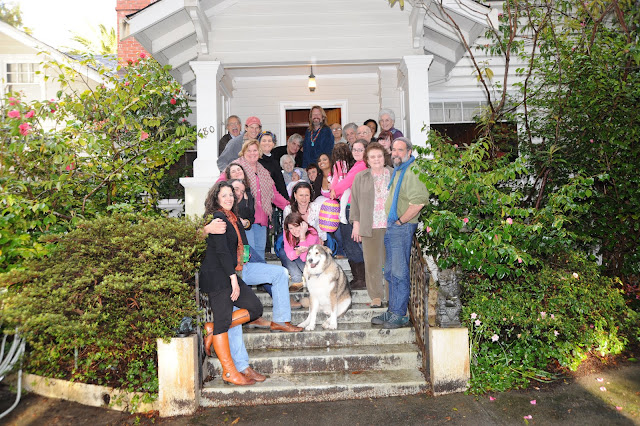
April 4, 2010- BGEE

April 4, 2010- BGEE
Best Greek Easter Ever

Saturday, May 14, 2011

Escaping The Complete Escape in Perth

What little I knew of Perth I mostly learned from my niece Laura Fayne and her great blog (and the inspiration for my effort here). She studied at Murdoch University in Fremantle the first six months of 2010 and loved it.
We ended up spending almost one week post-cruise here, a time needed not just for local touring but also (as funny as it may sound) recovering from the cruise, regrouping, and planning the final month of the sabbatical. The Princess motto is "Escape Completely", but ironically with all the 24-hour regimented social activities and queues, at the end we did want to escape from the most pleasant prison imaginable. Perth was perfect for that.
We spent the week at a very nice hotel right on one of the city's beautiful beaches, Scarborough Beach.
Sunset on the Indian Ocean
It was very restful, but a 45-minute bus ride to the CBD (central business district). We didn't spend a lot of time in the CBD, but what we saw was pretty nondescript, with a great deal of construction going on for no apparent reason. (Are the Olympics coming here next year and nobody knows?). We did the usual stops at the Western Australian Museum, where we caught up with the AC/DC traveling exhibit.
It attracted an atypical museum crowd, and I learned that original vocalist Bon Scott's death in 1980 was due to "acute alcohol poisoning" and officially ruled as "death by misadventure".

The most striking landmark in the CBD is the tower by the Swan River Harbour housing the Swan Bells.
Swan Bell Tower
The harbour appeared to be a favorite haunt of jelly fish.

Overlooking the CBD and Harbour is the Kings Park, with extensive botanic gardens,
 
a war memorial,
 
and CBD views.
Perth CBD
We came to think of Perth as a beach town, like Rio de Janeiro or Santa Cruz. It attracts surfers and sailors from all around the globe.
Scarborough Beach in Perth
In keeping with Australia's reputation as a place with all sorts of bad-ass creatures, there are some warning signs I'm not used to seeing on the Mendocino Coast
(Note the SNAKES!)
One "must-do" is a day trip to Rottnest Island 18 km off the coast. The name means "rat's nest" in Dutch as the early European explorers mistook the indigenous marsupial, called a quokka, for a very large rat.
A Quokka
Plenty of quokkas remain, as do other fauna.

The island has few cars and many pristine beaches

and is a popular destination for vacationing mainlanders.

[Side bar: A big part of the regrouping was laundry. This is a constant travel conundrum. No option is ideal. Hotel laundry is convenient, but can cost more than the room. If there is a guest laundry, it seems as if one or more crucial machines will not be working. More than once I have had to lug an armful of wet clothes from one floor to another looking for a functional machine. It is worse with foreign machines. In New Caledonia I put detergent in the dryer because I could not distinguish it from the washer. Ultra-light travelers say to buy high-tech, expensive fast-drying clothes and hand-wash in the sink daily, but that takes more time than you think and when you need them the most (i.e.: in hot, humid, sweaty climates), they are rarely dry the next day. Disposable togs may be the way to go, but you can't discard your favorite outfits.]

Our last day in Perth we ran into Alan and Rita, table-mates from the cruise (which I felt was a very good omen somehow.).
A&R
They also had to take a few days to recover from the rigors of non-stop pampering. It was good to see them, and we took the bus together down to Fremantle, past Cottlesloe Beach where Heath Ledger's family had a wake (and perhaps scattered some ashes).
We had a few hours to visit Fremantle. Highlights included Fremantle Prison,
 
where the aforementioned Bon Scott of AC/DC spent some time in his youth. They have erected him a bronze statue at the harbour.
A Bronze B. S. on Top of a Marshall Amp
We stopped in a port-side brewery for a cider and a gelato shop highly recommended by Laura Fayne (Yum!!), and then to the Maritime Museum Shipwreck Gallery for more relics salvaged from the Batavia (described in the previous blog from Geraldton).
The Salvaged Hull of the Batavia
Remains of a Batavia Mutineer


We pared our traveling luggage down to under 20 kg (22 lbs) for the next three weeks, then off to the airport for the red-eye flight to Cambodia via Singapore. We come back to Perth in three weeks to resume our visit to Oz. 

Sunday, May 8, 2011

Cruisin'- Part II: Bali and Beyond


My First View of Bali
BALI
It was with great anticipation that we arrived at Bali on April 29. So many friends and family advised us to not miss one of their favorite places. Before taking this trip, I did not realize how close Bali is to Australia and how frequently they visit. To Aussies, Bali is like Mexico to Yanks: tropical, Third World, cheap, exotic. The finer cultural points may not be of as much interest. We knew we had very limited time to get a glimpse of this special place, and we were advised to avoid the beach/urban/resort Bali and elected to take a day-long tour of the interior. My first view of the island was everything I would have imagined.
The ship anchored off-shore of a brand-new cruise-ship terminal in the southeast at Tanah Ampo.

It just opened last month, and there are a few bugs to be worked out. The pier was made too short for the standard cruise liner, so we had to take small boats ("tenders"). The dock could only handle one tender at a time, and the gangplank had to be secured by six people holding on to it, until a welding crew from the Sun Princess was dispatched.
Tenganan Village
It was a short ride to the ancient walled town of Tenganan. The people are called Bali Aga, descended from the original inhabitants and predating the arrival of Hinduism. They try to maintain their traditional culture, dance, music, and crafts (like palm leaf weaving and bamboo etchings). There were a lot of proud roosters in cages, some brightly dyed.
A Cock in a cage
Our guide assured us that while cock fights were once quite common, now they were only allowed for brief periods during religious celebrations (I have my doubts).
People had tried to prepare us for what we would see in Bali, but until we were there, we couldn't comprehend how many thousands of temples or shrines there are, in villages, homes, all over. You can't go 500 meters without passing ornate platforms with small offerings placed upon them. Due to the dense population, you can hardly go 500 meters without seeing people either. We traveled deep into the interior, to the slopes of the tallest and most sacred mountain, Gunung Agung, a volcano which last erupted in 1963.

The large complex of temples here includes the "Mother Temple" of Pura Besakih, which dates to the introduction of Hinduism from Java in the 11th century.
At the top of the steps is an inner sanctum.
 Covering our legs and ankles with a borrowed sarong, from a respectful distance we could watch some Balinese chant and pray.
To help prepare me for the visit, on Day One of the cruise I went to the library and picked up the copy of The Lonely Planet Guide to Indonesia. When I returned to my cabin, I discovered it was En Espanol. Regarding the view from el templo, they remark,"Si no hay neblina,la vista, hasta la costa, es seplendida", to which I say "Es verdad!".

There was scant time to walk through the vendors on the way back to the bus. Serious bargaining is the order of the day in Bali. We weren't in a shopping mood, partially because of Australia's strict and somewhat capricious rules about customs and wood products. I did buy a dollar's worth of postcards from a lovely local schoolgirl, but once we realized how phenomenally cheap the opening prices were, we regretted we didn't have more time to pick up a few regalitos (souvenirs).

We stopped for lunch at the peaceful Mahagiri Restaurant, perched on a hillside with terraced rice paddies below and the volcano in the distance.
After another lengthy drive, we stopped at a 19th century royal palace Puri Agung Karangasem in Amlapura on the far eastern side of Bali.
 
After a long, hot, sweaty, tiring, and special day, it was back to the dock. Due to the "kinks" mentioned above, it took 90+ minutes to catch a tender back to the ship.
The Queue
Back on board it was non-stop Royal Wedding coverage, complete with wedding cake. (I'm sure you all got up in the middle of the night to share the experience.)
Geraldton
The next two days at sea were our first windy and choppy ones. Because we left Bali late and the seas were rough, we arrived late to Geraldton, our last port of call before Perth. Situated 280 miles north of Perth, Geraldton is noted for wind, rock lobsters, and off-shore reefs called the Shipwreck Coast. The most famous wrecked ship was the Batavia, a Dutch trader that in 1629 ran ashore. This led to a bloody mutiny and probably the first two Europeans left behind to live in Australia. The wreck was finally located in 1963 and a great deal has been salvaged and displayed handsomely in the Geraldton and Fremantle Museums.

This beautiful portico was used as ballast for the voyage and was meant for a new building in Jakarta.
A more recent tragedy occurred in 1941 when the HMAS Sydney was sunk by the German raider Kormoran. All 645 men aboard died. The ship remains were located in 2008 in very deep water (8,097 feet) off-shore. A moving memorial has been constructed on a commanding hill in town. There 645 birds on the dome, one for each life lost.
 
The Sun Princess at Anchor In The Distance

After 17 days, we disembarked at Fremantle outside of Perth. It was time to get off and bid adieu to our temporary shipboard community, like the three Aussie couples we ate with every night, and our trivia partner Noel ("Leon spelled backwards", as he explained). As some of you might know if you have cruised, there are multiple trivia contests a day, and Fayne and I collected our fair share (maybe more) of the "cheap ship prizes" (say that carefully!) with the help of teammates. We needed Aussie assistance for the answer "golden wattle" (Q: What is Australia's Floral Emblem?).

Noel
FYI, the demographic profile of the passengers was interesting. Most were Aussies, so it was a bit odd to be in the definite minority as a Yank. Also, Fayne and I were at the lower end of the age group. My mother actually would have fit in well. There were a lot of people with mobility problems, and befuddlement with new tasks. It was whispered several times "You know there is a morgue onboard", and a lot of speculation as to how many passengers did not complete the voyage upright. But as one frequent cruiser said, "People are much younger here than on my last cruise. I thought they had emptied out a rest home and sent them on a cruise because it was cheaper. There was a long queue of ambulances at every port".
Right up my alley; in fact, God Bless them.
A Final Reminder of Our Itinerary

Saturday, May 7, 2011

Cruisin'- Part I

Sun Princess Itinerary April 16-May 3, 2011
Periodically I like to mix up my traveling with a cruise. I look for an itinerary that visits places I want to go but haven't been and that are complex and expensive other ways. This equation has worked well for us in the past for the Alaskan Inside Passage, around Patagonia and Cape Horn, and the Panama Canal. Around Australia from Sydney counter-clockwise to Perth also qualifies. It is also nice to settle into a berth for the duration (17 days in this case), and for me a bit of "forced relaxation" is a good thing.
Cruises aren't for everyone. The time for shore excursions is limited so you have to make the most of it. It is by definition superficial, but you can glimpse the essence of a place, and decide the places to which you want to return, and how you might spend your time. There is the whole cruise environment to deal with, the food, the entertainment, the mirth, and the socializing. At some point, you have to exercise some self-control lest you disembark giddy and twice your initial weight. But enough of the disclaimers: Let's set sail!

It was a dark and stormy evening when we left Sydney Harbour, and it was quite beautiful. After one day at sea, Brisbane was the first stop. With 1.9 million people, it is the major city in the state of Queensland, and perched alongside a serpiginous Brisbane River. They experienced some severe flooding earlier this year, but seemed to have recovered nicely.
It was raining on and off, sometimes quite heavily. After shopping for a few provisions, we explored the city on foot
and then boarded a "hop on/hop off bus", but because of the weather we stayed on for the whole loop. We also took a brief ride on the River Cat, the public water taxi. It seemed like a very nice place and worthy of a longer stay.
After a day at sea, we stopped further north at Townsville, a surprisingly large port in upper Queensland. It is near the beginning of the Great Barrier Reef and the rainforest. We decided to take a day trip inland to see the latter.
A very powerful Cyclone Yasi hit the area hard just two-and-a-half months ago, and on the ridges you could see many trees snapped in two by the 300 Km/hr winds.

Fortunately there was no direct loss of life as a result. We had lunch at a solar powered eco-lodge in a quiet place called Hidden Valley, saw some birds and wallabies, and on the way back stopped at a small waterfall picnic spot. One of the nice things about being on a longer cruise is you have an opportunity to mingle with some of the staff like Sarah, one of the ebullient dancers.
We had to tender by small boat back to the Sun Princess and I caught this sunset over Magnetic Island (named by Captain Cook).

Another day at sea, then we stopped at Port Douglas, north of Cairns. This is where we took a catamaran tour to the outer Great Barrier Reef. Sorry, no pics because there wasn't much to see above surface and I do not have an undersea camera. They had a large pontoon platform set up from which one could snorkel, scuba dive, take a glass bottom boat, and eat lunch. The water was a bit cloudy due to recent rain and wind, but you can spend hours looking at the huge varieties of coral and other sea flora and fauna. It will definitely be a highlight of the whole trip.
Port Douglas
So far, the path up the Queensland Coast has been over well-trodden tourist area, but not too many get to go around Cape York, the northernmost tip of the continent, and through the Torres Strait. It is a wild tropical area, difficult to get to, and sparsely inhabited.
Sunset Around Cape York
The many islands of the Strait are home to indigenous Australians quite distinct from the Aborigines. Their culture is more like Papua-New Guinea and Melanesia, as the islands stretch like stepping-stones a scant 120 miles across the water. The sea was quite glassy and calm when we came into Darwin on Easter Sunday, and the light was brilliant, the sea a stunning blue, and the soil mostly red.

Darwin
We expected a dusty frontier town but found a very pleasant modern town instead. Modern Darwin has been shaped by two major events in the 20th century. During WWII, Darwin was bombed multiple times by the Japanese, and the first attack was the same group that bombed Pearl Harbor earlier. Most Americans may not be aware, but three paces we stopped in northern Australia (Port Douglas, Darwin, and Broome) were all attacked by Japanese, with more bombs than at Pearl Harbor. Darwin suffered even more devastation from Cyclone Tracy on Christmas Eve and Day in 1974, which killed 66 and destroyed an amazing 95% of the homes in town. Like the phoenix, the town has been resurrected as a modern and more structurally sound city.
There a few awesome-sounding National Parks within a few hours from town, but not time to visit today. Darwin does have an excellent Museum and Art Gallery of the Northern Territories.
Termite Mound at Darwin Museum
There is a moving permanent exhibit on Cyclone Tracy, and an impressive display of Aboriginal art, and q 5.1 meter 780 kg. stuffed saltwater crocodile named Sweetheart.
Sweetheart
(We just missed the AC/DC exhibit.)

Decorated Chocolate Eggs on Board
Side bar: As it was Western Easter AND Greek Easter, we went by the Greek Orthodox church (there seem to be many more Greeks in Australia than New Zealand for some reason). It was pretty quiet, but I thought back to The Best Greek Easter ever 2010, the beginning of this blog. Anzac Day was the next day (April 26th), one year since we first arrived in New Zealand. So, lots of anniversaries to reflect upon. (Anzac Day is a Veterans'/Remembrance Day very important in Australia, marked with ceremonies on the ship)
Anzac Memorial Shipboard
Anzac Biscuits
Once you’re gone a year, it no longer is a vacation, it's just like you are gone. I've gotten a bit of feedback lately "the exotic travelogue is fine, but enough already. When are you coming home"? Trust me, it will be fairly soon: June 16 to LAX to be precise.

BROOME and the Kimberley Coast.
An extra bonus on this cruise was a late afternoon cruising Kimberley Coast, a very rugged, harsh, and isolated region on the north coast of the continent, noted for steep red cliffs, ravines and waterfalls, and Aboriginal land and rock art.
The Kimberley Coast
Our ship was able to go deeply into York Sound, almost surrounded by land, and enjoy the sunset.

The Kimberley Coast
A bit further west is the port of Broome, a boom and bust town founded by the pearl traders. They days of Japanese and Aboriginal divers risking their lives is thankfully over, but many pearl shops remain. It is now trying to develop into a resort site, but it is awfully hot and an awfully long way from anywhere else. There is the beautiful long sandy Cable Beach, so named because the undersea telegraph cable from Java connecting Australia to the rest of the world came ashore here in 1872.
Cable Beach
Pattern in the Sand from a crab
A popular tourist activity is to ride in a camel train along Cable Beach, ideally at sunset. Many camels were brought to Australia in the 19th century for transportation across the Outback, and they are found both wild and domesticated here. (I took a photo, not a ride).
I wasn't going to leave Australia without encountering some real live crocs. Mission accomplished at Malcolm Douglas Crocodile Park.


The town also has a small museum,

pearling exhibits, a very nice brew pub Matso's, and an open-air cinema.
 So far, the cruise of Australia has been great. Now we set sail across the Timor Sea to Bali. (to be continued....)