April 4, 2010- BGEE

April 4, 2010- BGEE
Best Greek Easter Ever

Friday, June 10, 2011

China Part III: Shanghaied in Ghangzhou

The Bund by day
Shanghai- "Eddie" (Tau Ee)
The story of Shanghai parallels the story of China and our guide “Eddie”. A generation ago, they were in the 18th Century, and in the last generation have been catapulted into the 21st Century. Shanghai was one of the ports forced open by European powers, even carving out autonomous neighborhoods, or “concessions”. The Bund is the name given to the string of colonial buildings on the west bank of the Huangpu River.
The Bund by night
The east side, Pudong, was literally rice paddies two decades ago, and now has a skyline to rival Manhattan with some of the tallest buildings on the planet. On our first evening we took a brief cruise along the Huangpu River to take in the stunning show of lights.
468 m. high Oriental Pearl Tower

Shanghai is the financial center of the new China, rivaling Hong Kong, and evidence of this new wealth is everywhere, from the skyscrapers to the state-of-the-art shopping malls.
Skyline view from our hotel room
We even found the local Hooters, whose motto is “Hooters makes you Happys”
.
“Eddie “is around 30, married to an accountant with a new infant daughter.
He did not know indoor plumbing until his late teens, and grew up in a “Stone Door House”, a large colonial house now shared by up to 10 or more families. His grandfather was a victim of the Cultural Revolution in the 1960’s and 70’s. As an accountant, he was considered too intellectual, elitist, and counter-revolutionary, and was sentenced to years of farm labor and prison. Through education, “Eddie” became a tour guide and has been able to travel overseas much more than most. Shanghai, as a port city, has a much more cosmopolitan attitude than inland cities. The people are more tolerant and accustomed to foreigners. There was even a significant Jewish population in the 19th and 20th centuries (only a handful now, but a synagogue has been turned into a museum). “Eddie” reflected this openness, even extending to the Japanese, still resented in much of the country for atrocities during the 20th century wars. He was not as sympathetic to ex-patriot Tibetans, repeating an argument we heard ad nauseum (“Tibet has always been part of China, look at all we have invested to improve their lot, yada yada yada”). State-run TV repeated endlessly “Today marks the 60th anniversary of the peaceful liberation of Tibet by the Red Army”. It was liberated from Tibetans, I guess.
“Eddie” also shared an “only in China” story about his wife’s sister. She was the second child born to her mother despite the strict “One Child” policy. When the “family planning” agency found out, they tried to force her to have an abortion. The woman fled to the country, was found, escaped again, until the pregnancy was too advanced for a safe abortion. After the birth, she couldn’t pay the hefty fine, so the child was unrecognized by the government. That meant no health care, immunizations, or school. Fortunately the girl was healthy, survived to the age of five, when she was finally documented with papers.We tried to impress upon “Eddie” how mind-blowing all that was on so many levels from an American point of view.
But I digress (as usual). There were still sights to see in Shanghai. These included the Jade Buddha Temple, so-named for the two exquisite white jade Buddhas (no photos please).
Buddha, not jade


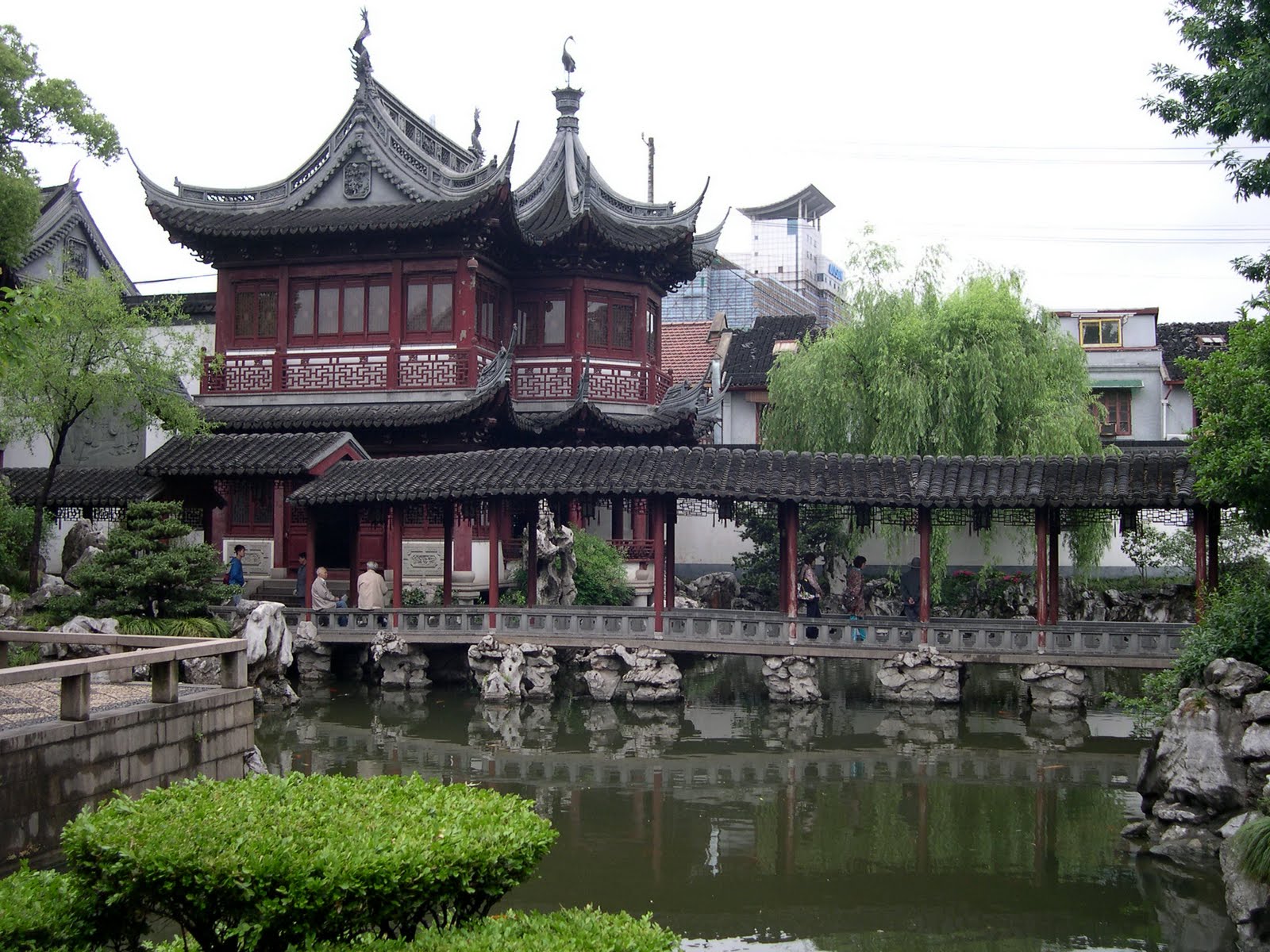
Another popular spot is the Yuyuan Garden, a peaceful 550 year-old classical garden in the center of the city.
.

We also saw Nanjing Road, a major shopping district.
We did not have time to ride the Maglev train, a super-fast magnetic levitation train from the city to the new international airport. Designed by German engineers made to go up to 311 mph, it seems like science fiction. Instead we flew out of the domestic airport to our next stop....
Haibao, Unemployed Mascot of Shanghai Expo 2010
Guilin- "Lizzie" (Mo Wei Li)
"Lizzie" showing us the spot on the Li River pictured on the 20 Yuan bill
"East or West, Guilin scenery is the best."- Wang Zhenggong, 12th Century poet
"Guilin is like a pretty girl in old worn clothes."- Bill Clinton

The two quotations above explain a lot about present day Guilin. The first is from a famous poem and a very early example of PR which helped to establish the area’s reputation as a scenic wonderland 900 years ago, although it must sound more elegant in Chinese. The second comment was made during a Presidential visit in the 1990’s (imagine it said with Bill’s smoky Arkansas drawl). More than once we were told this comment is credited with spurring the government to commit its resources to upgrading the province into a popular tourist destination. New hotels, bridges, roads, and airports have been constructed, and heavy industry has been moved out to improve the environmental quality.
Pictures of the area will be familiar to some from classical Chinese landscape paintings.
 “Lizzie”, our guide said Guilin is famous for four things: mountains, caves, clean water, and rocks. It is the dramatic and improbably steep hills of limestone karst which leaves the lasting impression.
 
First stop on the agenda was Elephant Trunk Hill, a rock formation dipping into the Li River, which does somewhat resemble a pachyderm.
Then it was off to Reed Flute Cave. Much like a cave experience from the US in the 60’s, it featured garish lighting, piped in music, and a dogged determination to make sure we “saw” the named formations: “Look, a mother lion!”; “See, two old men playing chess”, etc. Fayne could only see Buddhas, and I saw mainly stalagmites and stalactites, and little concern for what is a delicate ecosystem.
"Crystal Palace of the Dragon King", or something like that
The town of Guilin itself was a pleasant break for us. It was cooler, with plenty of trees and water around, and more bicycles and electric scooters than cars.
Pagoda of the Sun and Moon, Day
And Night

There were plenty of outdoor cafes with good international cuisine, and “only” about a million people. We also had more time on our own, so it was more relaxing, and I had time explore some on my own, including climbing up to hilltop pagodas and shopping for souvenirs.
The highlight was a cruise on the River Li winding through the unique landscape.


That afternoon I continued my wandering mostly with Chinese to the old city center, now Princes City Park and home to a university.

Guilin means the Forest of Sweet Osmanthus. We found a local pastry stuffed with a paste from the osmanthus fruit, and washed it down with some 106 proof local rice wine.
“Lizzie” is a local young lady, less experienced and well-traveled than out other guides, very cheery, and truly astounded when we answered any of her questions correctly (“How did you know that?!?!”) She was working on her English, and we tutored her on the proper pronunciation of “zoo”, “Chanel”, and “Rolex” (many are for sale on the streets).
Rules posted at Princes City- I hope you can read them
Riverside cormorants used for fishing
Guangzhou- "Phillip" Huang
On leaving Guilin, we were routed to fly to Guangzhou, have a whirlwind 4 hour drive-by of that city, to then catch the train to Hong Kong. I have no idea why they didn’t just fly us directly to Hong Kong. It felt almost as if we were “Shanghaied” to Guangzhou. I suspect it has something to do with the fact HK, despite being part of China, is still treated as a different country. You have to go through customs from the mainland to there, and mainland Chinese need a special visa to visit. Or it may have been they wanted to be sure we were "educated" by "Phillip".
This guide “Phillip” was closer to our age, so I asked him what his experience was like during the Cultural Revolution. He proudly admitted he was in the Red Guard, and while perhaps there were some excesses and it wasn’t such a good time for some academics, overall it was a good thing. He is still a proud Party Member, and reminded us that Mao did not use his power to amass great personal wealth. He did not really want to discuss the temptations brought on by the current flow of riches, and repeated how this was “Chinese-style socialism”.
Guangzhou was known to the West as Canton, the first international trading port, and has a rich history, but the current city is very large and busy, but largely undistinguished. It seems to have an inferiority complex in comparison with its two shinier sister cities Hong Kong and Shanghai.
"Phillip", Sun, & Me

The Sun Yet-Sen Memorial is a beautiful modern edifice with a large auditorium, dedicated to the Father of the Chinese Republic. Both the Nationals and the Reds want to claim him, so we got to hear the mainland side of the story. His widow did become a high-ranking Communist official, while her sister was Mrs. Chiang Kai-Shek. Interesting family, the Soong sisters.
The next stop was at the Chen Family Temple, originally built with funds from this giant family line in China, to host gatherings and ceremonies for ancestors. As I understand it, that kind of activity is no longer allowed, so the building has been converted into Guangdong Folk Art Museum. You could spend a very long time going through the intricate embroidery,
Embroidery
Wood, brick, and stone carvings, engraving, pottery, and on and on.
Our guide insisted on driving us by the latest really tall buildings and TV towers erected, as they see-saw back and forth with Shanghai for the honor of having Asia’s tallest.

During our mad dash on the way to the train station, we had a very surreal exchange, as I looked out the window and asked, ”Is that a giant peanut?” It was (sorry for the poor photo), with no explanation.
Perhaps it was an homage to the farmers paid off and displaced to high-rises to make room for the skyscrapers.
Hong Kong- Finally
We made it to Hong Kong, where most people do speak English. We stayed at a luxurious waterside Harbour Grand Hong Kong with a tremendous view of the lights. It was worth it to upgrade to the Club level, as that gave us free access to the penthouse lounge, buffet breakfast, internet, and other numerous amenities.
The concierge was the best, and gave us solid-gold tips on transportation, and the best Dim Sum ever (I learned “dim sum” is a noun referring to the dishes and “yum cha” is a verb used to indicate the activity, as in “Let’s go to yum cha”.)
As you might guess, Hong Kong is All About SHOPPING! In the streets, Chinese Emporiums, ultra-high end malls: it has them all, in spades. You really can’t believe it.

The #1 tourist attraction is to take the tram to the Peak overlooking Hong Kong Island. With a one-hour wait in line and air so thick it was hard to see the harbor it was a big disappointment.
The books all recommend taking the Star Ferry for an old-fashioned trip across the harbor to Kowloon. I liked it, Fayne not so much.
Accidentally Impressionistic Photo of the Star Ferry
Hong Kong is the name of the main island in the group, and across Victoria Harbor is Kowloon, the peninsula at the end of the mainland.
Kowloon Skyline
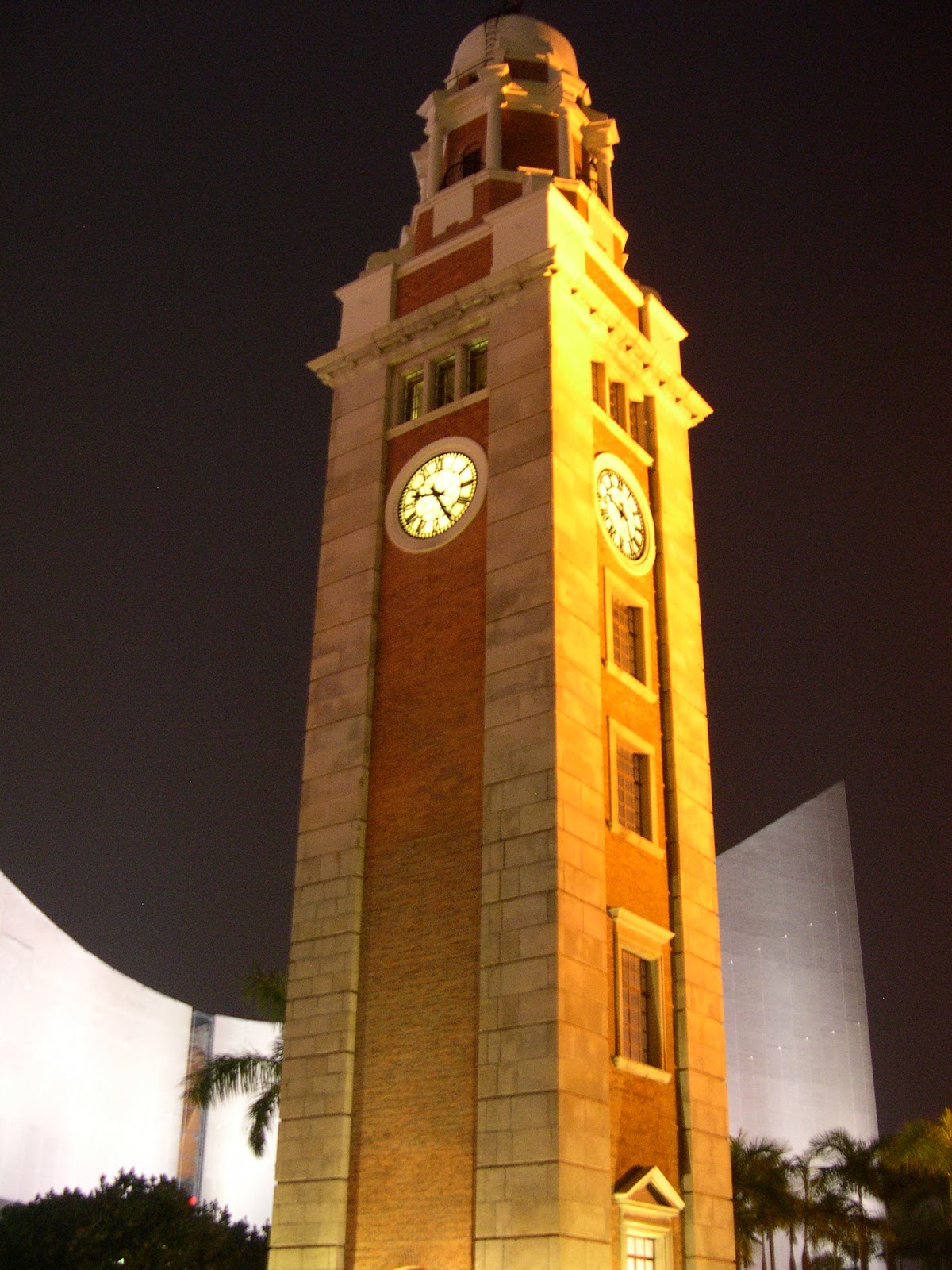
Clock Tower

Another attraction is the Big Buddha, the “World’s Largest Outdoor Seated Bronze Buddha”.
It is fairly new, and several islands away from the city center (on the backside of the island with the airport and Hong Kong Disneyland), but worth the trip.

The Buddha and his handmaidens were quite enchanting.


The last day, I tried to sample roast goose at a restaurant famous for it. No luck, they ran out, but I could gaze at some through the window.
Goose in Yung Kee window
 It was three nights in HK, then back to Perth, Australia for the last three weeks of our sabbatical. Wow.

Monday, June 6, 2011

China Part II: Ancient Emperors and Present-day Pomegranates

Xi'an- "Jenny" (Dai Qin)

 “Jenny”, our guide in Xi’an is a law school graduate, wife of "Peter", and mother of a small son Peter Jr. She plans to take the bar again in a few years after her son is older, maybe to specialize in Family Law as divorce is increasingly common in China. She is very bright, speaks English extremely well, and has a good sense of humor. We learned many things from her, such as:
1) In China, the failure rate for the bar exam is 90%;
2) Chinese can be divided into noodle eaters (from the North like Xi’an, big and strong) vs. rice eaters (from the South, not so big and strong);
3) In China, if your one child is a son, you need to buy him an apartment or he will never marry. As the government owns all the land, you can only lease it for 70 years, but you can buy the building on it. (We taught her the word “condos” and “time share”.);
4) Chinese ghosts are feared, but short, have no knees, but hop around (we learned this from “Ariel” in Beijing, too, but really, can you hop without knees?).If your door threshold is high enough, you can keep the ghosts out of the house; and,
5) China's four great gifts to mankind are gunpowder, paper, movable print, and the compass (facts also emphasized by "Ariel").

Xi’an ("Western Peace") was the capital of Imperial China from its founding by the Emperor Qin in 221 BC until the Mings moved it to Beijing in 1403 AD to keep a closer eye on those pesky Mongols. The modern city is generally quite unlovely, but fortunately it was raining so the smog was not as intense as Beijing. The area became a required stop  on any China tour after a local farmer found some terra cotta shards while digging a well in 1974. At first he didn’t think much about it, but after he found a few more he thought it wise to tell the authorities. This led to one of the most significant historical finds of the 20th century, Emperor Qin’s tomb complex.
Our only full day in Xi’an was packed to the brim with tourist activities. The first stop was they factory where they make replica terra cotta figures.
For about $1200, they will make a head to your likeness and put it on a body (a warrior is the cheapest, general or emperor more expensive).

About one hour out of town is the site of Emperor Qin's burial complex. It is a vast area nestled amongst pretty hills surrounding three massive pits showing the excavations. In a nearby hillock lies buried the as yet still undisturbed Tomb of the Emperor.  Pit One has the famous terra cotta army. There are infantry, archers, and charioteers with horses. Every figure is unique, with different facial features, expressions, even palm-lines.
It is not known why, but not a single one was intact and all had to be reassembled from many pieces.

There is a "hospital" section when more figures are being put back together.
 In Pit Two, higher officers, guards, and horses were found.
 And Pit Three showcases the remarkable reconstruction of two royal carriages made of bronze, complete with a team of horses and fully functional tack.
 
 As with every site in China there was a vast shop to sell handiworks and souvenirs of all kinds. We had heard that the farmer who made the discovery, Xanxing Mang, was now retired and wealthy, but liked to hang around the gift shop, autographing books. Sure enough, like Elvis' Uncle Vester Presley at Graceland, he was there madly signing books. (He made it clear to me how much of a gratuity he expected).

After lunch on site, we headed back into the center of the old town. The highlight there was the Big Wild Goose Pagoda, built in 652 AD.
In 645, the most famous Buddhist monk in Chinese history Master Xuanzang returned after his legendary 17-year sojourn to India with a library of Buddhist texts and statuary. These were stored in the Pagoda, but now are gone (possibly a victim of the Cultural Revolution?).
Also on the agenda was a whirlwind visit to the Shaanxi Historical Museum, with galleries full of relics from the Golden Ages of the ancient capital.   


Bronze Wine Vessel
Buddha
Bronze Lantern Hook
Han Statuette

Magic Ceramic Teapot
Later Emperors were entombed with miniature terra cotta armies
We finished the night with a performance dedicated to the arts, songs, and dance of the Golden Age of the Tang Dynasty.
This was followed by a Xi’an tradition: an eighteen course dumpling feast. Each dumpling had a different stuffing, and were folded origami-like to reflect the contents, like pig or walnut.
Phew! What a full day. But as I wrote last time, the guides had a dogged determination to complete everything on the itinerary. When we settled for a drive-by of the Bell Tower after dinner instead of walking up the steps,
“Jenny” had me sign a statement saying since I had seen the one in Beijing, I declined (part of her legal training to CYA, I’m sure).
Xi'an is also noted for the intact old city wall. We had time for a stroll on its ramparts before being whisked off to our flight to Shanghai.
In a touching moment, "Jenny" gave Fayne a jade bracelet, with strict instructions not to wear it until returning to the US, because the good fortune it bestowed would be deposited wherever she first wore it.

Perhaps you noted an attractive red creature in previous photos? It is not a tomato, but is a pomegranate flower, called Chang'an Flower, and is the official mascot of the World Horticultural Expo 2011 in Xi'an. It was lurking everywhere: airports, temples, public places. Was I going mad?
 
I bought a pin at the airport to try to break its spell on me.